Showing posts with label FIGHT CARD SHERLOCK HOLMES. Show all posts

Saturday, March 7, 2015

THE TRADITION CONTINUES!

THE TRADITION CONTINUES!

FIGHT CARD: SHERLOCK HOLMES...

E-BOOK

 
PAPERBACK


Thursday, March 5, 2015

NOW AVAILABLE IN PAPERBACK!

NOW AVAILABLE IN PAPERBACK

FIGHT CARD SHERLOCK HOLMES: BLOOD TO THE BONE

AUTHOR: ANDREW SALMON
COVER: MIKE FYLES
BOOK DESIGN: DAVID FOSTER

FIGHT CARD SHERLOCK HOLMES: BLOOD TO THE BONE

Deptford, England, 1888 … Richard Stokes – one half of a tag-team carnival boxing duo – has vanished, leaving his loving wife, pugilist Eby Stokes, homeless and penniless with only questions and no answers. A mutual friend asks Holmes to look into the disappearance.

Watson believes the matter to be a common case of abandonment, and Holmes’ interest merely an excuse to try his hand in the boxing booths of a visiting circus. However, when they are almost killed, Holmes and Watson’s only remaining clue to Stokes disappearance harkens back to a boxing club disbanded in shame more than sixty years earlier. 

Why did Stokes abandon his wife? What possible significance could the long extinct Pugilistic Club have in the matter? Who is behind the fire that almost took the lives of Holmes and Watson?

Joining forces with Eby Stokes, Holmes and Watson are determined to find the answers. The kaleidoscope lights of the carnival hide many secrets, including a threat to the foundation of the British Empire.

The game's afoot and, this time, it's a matter of life and death in and out of the ring…


Monday, March 2, 2015

BSB REVIEW FIGHT CARD SHERLOCK HOLMES II

BSB REVIEW FIGHT CARD SHERLOCK HOLMES II

THE REVERED BAKER STREET BABES BLOG HAS ALSO GIVEN FIGHT CARD SHERLOCK HOLMES: BLOOD TO THE BONE A RAVE REVIEW ...


While Work Capitol was full of links to the Canon, Blood to the Bone refers more frequently to historical events of the 1880s, ending with a fictionalized explanation for one of the most famous photographs in history (which I will not name, as it would spoil the effect). I enjoyed the historical links and references very much, and loved the solution of the story, which reads almost like an action film – the images conjured up by Salmon’s words are that vivid.

But what sticks most about this story is the lady fighter who is written as a much more complex character than Doyle usually wrote his female characters. She is strong and vulnerable, loving and vengeful, independent and a team player, and she gets an ending very deserving of her character...

FOR THE FULL REVIEW CLICK HERE


Monday, February 23, 2015

BAKER STREET BABES REVIEW FIGHT CARD

BAKER STREET BABES REVIEW FIGHT CARD

THE REVERED BAKER STREET BABES BLOG HAS GIVEN FIGHT CARD SHERLOCK HOLMES: WORK CAPITOL A RAVE REVIEW ... 

The case itself is a complex and dangerous one, which sees Holmes and Watson having a close brush with death more than once, and every bit as good as Doyle wrote his cases. I had long wanted to read this story, but was kept from it by work, but now that I sat down again to read it I couldn’t stop and finished it in one go. It’s beautiful prose and while not always sounding true to Doyle, the writing style draws you in and involves you almost physically. Salmon makes you feel the incredible heat of the place when Watson steps inside a crowded bar from the bitter cold. There are many passages in the text where I just stopped to enjoy the words, which is a rare thing in Sherlock Holmes pastiches or any kind of novel these days.

FOR THE FULL REVIEW CLICK HERE


Friday, November 29, 2013

THE TWO-FISTED HOLMESIAN TRADITION CONTINUES


RENOVATING SHERLOCK HOLMES FOR FIGHT CARD

RENOVATING SHERLOCK HOLMES FOR FIGHT CARD

AUTHOR ANDREW SALMON TAKES US INSIDE THE WRITING OF FIGHT CARD SHERLOCK HOLMES...

GETTING AN ICON INTO THE RING

I've been a Fight Card fan since Day One. Having read and reviewed many of the titles, it didn't take me long to get a sense of the quality of the books and soon a longing to be a part of the fun kicked in.

I was on the outside looking in, dreaming of one day being able to contribute to this fine series when I received an email out of the blue from Paul Bishop. Would I be interested in contributing to Fight Card? Uh, yeah! Would I be interested in writing Fight Card: Sherlock Holmes? Hell, YEAH! And that was all it took. Suddenly I'd been invited in out of the cold where it was warm and jumping! And, a chance to write Holmes in a new way? This was an opportunity too good to pass up!

Discussing the project with Paul, we hit on the framework of a traditional Sherlock Holmes tale except with bare knuckle boxing in it. Sacrilege you say? Not traditional you cry? Shades of Robert Downey Jr. – abominable. 

Well, Doyle himself created Holmes as an accomplished boxer, as well as an accomplished ... just about everything else! So what was the problem? As I had written Holmes and Watson five times before getting the nod from Paul, I felt I had a good handle on the characters and could shoulder the workload though no one other than Doyle can ever truly master this dynamic duo.

As the plot began to take loose shape, I soon found myself faced with the biggest challenges and crucial questions: How does one describe a Victorian boxing match? What was the language of the ring in the 1880s? What boxing techniques existed at the time? And what were the rules? All of these would have to be answered before Holmes could throw a punch. Historical accuracy is something I strive for every time I sit down to bang out an historical action tale. With bare knuckle boxing alive and well all over the world, there is a quiet legion of fans who have taken the time to stitch together the history of the sport for posterity and regularly visit the graves of long-dead champions of old to pay their respects. 

There was no way I was going to have Holmes step into the ring without having done my homework. Lots and lots and LOTS of research followed as I stuffed my brain with bare knuckle boxing history via the library and the internet to get a sense of where bare knuckle boxing was at in the 1880s. Michael Blackett, the guy at the helm of the History of Bareknuckle Boxing facebook page, sent me links to his website with articles among which were a few on how boxers toughened their hands back in the day. Holmes follows a version of the tried and true methods. 

The most important question of all, however, was how would Dr. Watson describe a Victorian fight? Remember the adventures of Holmes are chronicled by the good Doctor – not only a man of his time, but also, arguably, the greatest fictional narrator of all time – and it was vitally important to hit on the right tone, get into Watson's head as he watched his friend toe the scratch line and start swinging. I had to have a handle on it before putting words at the end of Watson's pen.

The result of all this was the chance to step into a fascinating lost world. Bare knuckle boxing was illegal by the times Holmes and Watson first hopped into a hansom. It still thrived, but underground on a much smaller scale. The heady days of champions, big purses and massive crowds were long over by the 1880s.

And the tale had to take place in the 1880s. Boxing is a young man's sport and as we know Holmes was born in 1854, he would have been 26 in 1880. Sherlock Holmes chronologies abound as over the decades Holmesians have tried to create a timeline for the original adventures and those that have followed. There's no definitive chronology, so I had to pick one that seemed best suited to my tale. 

Proceeding from the first meeting between Holmes and Watson in 1881, the year 1884 was easy to settle on. Of course, the biggest reason for setting my tale in 1884 was the canonical reference to Holmes having been in the ring during a benefit for a retiring boxer named McMurdo in A Sign of the Four

Said benefit, according to Holmes when he meets the retired fighter in 1888 in chapter four of A Sign of the Four, having occurred four years previously – thus 1884, when Holmes would have been 30 years old. My tale opens with this exhibition bout, which is only alluded to in the Doyle novel.

With the history established, it was time to put Watson ringside for the fights. To the challenges above was instantly added the task of making the fight interesting and dramatic. Fight Card books use the first-person perspective so the reader can feel every blow and punch away with the protagonist against his or her opponent. 

Watson, for all intents and purposes, was standing on the sidelines watching the fight happen to someone else. The Holmes tales are usually told with some measure of detachment – after all with Watson writing the tale years later, we know nothing fatal is going to happen to him no matter what the situation – so I knew missing out on feeling every punch would be overcome by the subject matter. 

Also, it's up to the writer to squeeze as much drama as possible while playing into the conceit the reader knows in the back of their mind that the heroes will win the day. I called on my time in Watson's shoes over the last few years to play the fights out and it's up to readers to tell me if I succeeded.

The last piece of the puzzle was the fighting style Holmes would use. Holmes is described as being a tall man, which would give him the benefit of reach over most opponents. Also his calculating brain coupled with his amateur status would, I reasoned, make him somewhat cautious as he tested his opponent's abilities and style while determining the best approach to counter them.

Thus I made him an accomplished counter-puncher who, after some sparring, could guess what his opponent would do before he did it and prepare the appropriate response. I did borrow from gloved boxing by giving Holmes Ali's uncanny ability to stand toe to toe with his opponent, gloves lowered, and twitch his head this way and that dodging blows. I could see Holmes doing this, using his height, and wanting to get as close to his opponent for the purpose of study.

As any Holmesian knows, Sherlock Holmes was the first fictional mixed martial artist, practiced in the many disciplines of Bartitsu or Baritsu as Doyle calls it in The Adventure of the Empty House when he is describing how Holmes got the better of Professor Moriarty. But this was a boxing tale, so I kept these abilities in check for the most part.

The mystery elements of the plot came about through an organic process. To be honest, I did not know how the first murder took place or the identity of the murderer. I decided, instead, to come at the case as Holmes would: finding a body, examining the scene and putting the pieces together. 

This method made for some nervous moments as I moved Holmes and Watson through the story ever closer to the end when Holmes was to begin revealing all while I had no idea how it all tied together. My salvation came in the form of that weird scenario only writers know ... Holmes, himself, explained the case to me one night as I pushed my pen across the paper. I just wrote down what he told me as fast as I could then got on with the tale.

This is not unusual. As Holmes and Watson are the characters I've written the most in my career to date, they often have conversations in my head on a variety of subjects, and I've found I've come to know them quite well. Which is why I'll be writing them again soon. I've got an inkling for a second Holmes boxing tale and a full-fledged idea for a third fight adventure. If readers like this first one, I'll gladly get to work on more. It's up to you, fight fans. If you want more two-fisted action from Holmes then sound the bell and we'll toe the line for another round or two.

Until then I want to thank Paul Bishop and the Fight Card crew for giving me a shot at the title and doing the heavy lifting in getting this book ready to be unleashed on an unsuspecting world. Writing it was a blast and I hope I'll get a chance to do it again. Keep punching, folks!


Wednesday, November 27, 2013

AVAILABLE NOW: FIGHT CARD SHERLOCK HOLMES!

AVAILABLE NOW: FIGHT CARD SHERLOCK HOLMES!

FIGHT CARD'S HOLIDAY EXTRAVAGANZA ... THE WORLD'S MOST FAMOUS DETECTIVE IS READY TO RUMBLE ...

FIGHT CARD SHERLOCK HOLMES: WORK CAPITOL

London, England, 1884 ... What happened when Sherlock Holmes stepped into the exhibition ring against retiring prize fighter McMurdo four years before The Sign of Four? What incident was Holmes recalling between Mr. Mathews and himself in the waiting room at Charing-Cross in The Adventure of the Empty House? Sherlockians have wanted to know for decades. The answers can be found in Fight Card Sherlock Holmes: Work Capitol...

Victorian Slang for a crime punishable by death, Work Capitol finds the world's most famous consulting detective – accompanied by the ever stalwart Dr. Watson – chasing a diabolical murderer through the dark, illicit, world of Victorian bare-knuckle boxing. To solve the case, Holmes must take a desperate chance, toeing the scratch line opposite London’s most dangerous pugilist – Ezekiel Tanner...

Sometimes the simplest crimes hide the darkest secrets ... And this time, Holmes and Watson know brawn will count as much as brains...


HOLMES AND FISTICUFFS

HOLMES AND FISTICUFFS

IN ANTICIPATION OF THE PUBLICATION OF FIGHT CARD SHERLOCK HOLMES: WORK CAPITOL, AUTHOR ANDREW SALMON GIVES US A LOOK AT HOLMES' PUGILISTIC SIDE ...

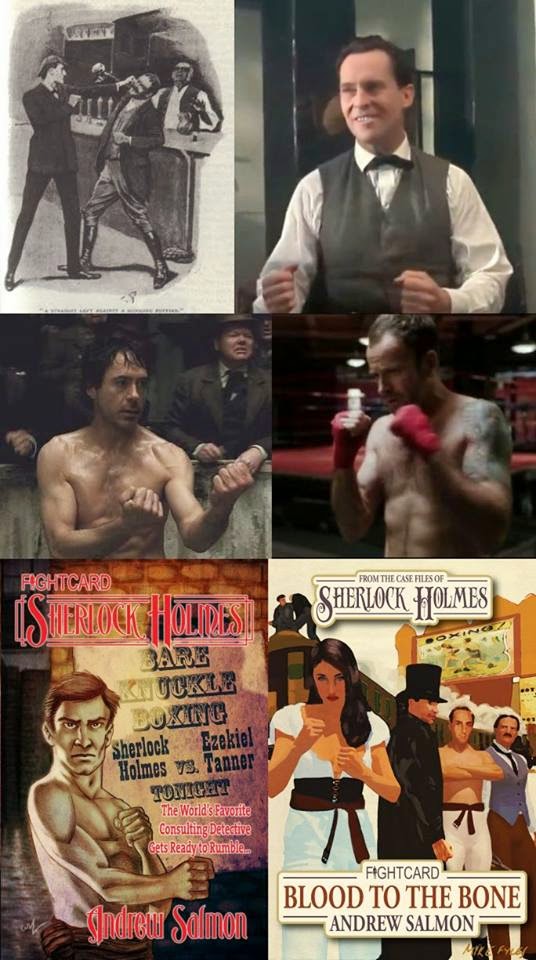
A STRAIGHT LEFT AGAINST A SLOGGING RUFFIAN

SHERLOCK HOLMES AND THE SCIENCE OF DEFENSE

ANDREW SALMON

When the trailer for the first Robert Downey Jr. Sherlock Holmes film was released, it took less than a nanosecond for the Holmesian world to tremble. The film portrayed everyone's favorite consulting detective as a kick-ass action star, which did not sit well with Holmes traditionalists.

To this day, I'm not quite sure why.

In the original tales, Doyle describes Holmes as an expert in Baritsu, making him a mixed martial artist. He is also described as a crack shot, good with a sword and singlestick fighting. And, yes, Holmes is not just proficient at boxing, but good enough to turn pro according to a former boxer he goes toe to toe with in one of the canonical tales.

For the sake of this piece, we'll concentrate on boxing. In The Sign of Four, Holmes reminds the former boxer, McMurdo, that he had fought an exhibition bout with him at Alison's rooms four years previously – a scene I use to kick off my Fight Card Sherlock Holmes tale – and McMurdo's comment that Holmes could have turned pro if he so desired is not faint praise coming from a former professional fighter well aware of the dangers of the ring. 

Later in the canon, Holmes gets involved in a bar fight in The Adventure of the Solitary Cyclist and uses his boxing skills against a slogging ruffian to come out on top. He alludes to having a tooth punched out in the waiting room of Charing-Cross in The Adventure of the Empty House without further explaining the event, which left me free to do so in my tale. 

So where did he acquire his boxing skills? They can't be mastered from a book, can they? The only answer is Holmes mastered them in the ring. His bout with McMurdo simply could not have been his first and last. It's clear Holmes had taken the time to learn how to hit and get hit, developing his skills by applying what he learned.

So what's the problem? Holmes is a tough customer. It's as simple as that. Given his chosen profession, he would have to be able to defend himself, right? My opinion is the naysayers were used to reading Doyle's descriptions of Holmes merely possessing these abilities whereas the new films showed Holmes demonstrating these abilities. 

Holmes as an action star? You betcha! It's how Doyle conceived and portrayed him and holds true for the current incarnations. We got to see Jeremy Brett demonstrate Holmes's boxing skills back in the day and though Benedict Cumberbatch has yet to throw 'em, the Downey films are full of Holmes fights, and even the folks behind Elementary have given us Jonny Lee Miller showing us Holmes working off his frustrations on the heavy bag in a recent episode. 

Holmes is the thinking man's action star. He can still outthink, out deduce and outwit all comers, but he can also put you on your ass if you want to start trouble.

What some view as an added dimension to the character shoe-horned in for a modern audience has been there all along and showing it in the current adaptations helps to round out the character. Of course, it's vital the physical stuff not take over the whole show. Holmes is the smartest guy in fiction and brain must always triumph over brawn. 

Given the countless adaptations of Holmes in every medium imaginable over the decades, seeing Holmes in a new light refreshes the character. The success of shows like Sherlock and Elementary and the Downey films are bringing new fans into the Holmesian world where they will, hopefully, seek out the original tales and the ones that have followed. 

Holmes is king! And I wouldn't try to knock off his crown. Not if you know what's good for you.

Tuesday, November 19, 2013

FIGHT CARD SHERLOCK HOLMES!


FIGHT CARD SHERLOCK HOLMES!

IN ANTICIPATION OF FIGHT CARD’S DECEMBER RELEASE, FIGHT CARD SHERLOCK HOLMES: WORK CAPITOL, AUTHOR ANDREW SALMON PROVIDES US WITH A VICTORIAN BARE KNUCKLE BOXING PRIMER ...
Boxing has evolved and changed since ancient times and boxing in Victorian times was a different animal than boxing today. In the early 1800s, bare knuckle boxing was king. Earning lavish purses, toasted wherever they went, hired as boxing instructors or bodyguards for the rich aristocracy, who also funded their bouts, bare knuckle fighters (or rawsmen) were the rock stars of the day.
Fighters lived fast and hard, spent their fortunes without a thought, usually dying young from drink, the long-term effects of their sport, or from diseases that were beyond medicine at that time. This up and down lifestyle made it common for fighters to know the inside of a debtor's prison or seek work as porters, blacksmiths, and on the docks between fights. Some survived the sport such as John Gully who was elected to Parliament. Most died poor and destitute.
The fights themselves were raw, brutal affairs until The Pugilistic Club was formed in 1834 as a governing body to regulate fights, make sure fighters were paid, and retained an official ring-maker. This lead to the Prize Ring Rules of 1838 which created some guidelines for bouts, eliminating head butts, hitting or kicking a man when down, and outlawing spiked boots or cleats.
Stripped to bare chest and britches, a fighter would step into the ring, tie his colors to a corner post, proceed to the middle of the ring.  There, a scratch line would drawn in the sawdust, sand, or earth (if the fight was outdoors).  The fighters would toe the line and begin fighting until one or both fighters were knocked down. At which point, the scratch (or round) was over, and both fighters had to return to their corner. Rounds lasted until a knockdown, so a single scratch could last from mere seconds to forty-five minutes or longer, depending on the skill of the combatants.
No stools were provided in the corners, in fact using one was considered a foul. Rather one of the fighter's seconds would go down on one knee, creating a bench for the fighter to sit on to take water from a damp sponge. From the moment a fighter retreated to his corner, he had thirty seconds to return to the scratch line in the center of the ring, toe the line, and resume fighting. If he didn’t (or couldn’t), the fight was declared over and the fighter still standing was the winner. Wrestling throws and grips were also permitted and an integral part of the fight, which were usually refereed by two umpires.
These fights eventually gave way to the Queensberry Rules of 1867, which instituted three-minute rounds, with a minute's rest in-between, established the standardized ring, and also abolished the thirty-seconds to scratch rule. A downed fighter was counted out backward, from 10 to 1, not like today where the lone referee counts up from 1 to 10.
The terminology of the ring was also different than it is today. To retreat after sparring was called breaking ground. If a fighter maneuvered to the right or left to gain a strategic advantage, it was referred to as taking ground. Colorful terms were also used to describe various parts of the body. The torso itself was the mark. The nose was often referred to as the smeller, whistler, beak, snorer, sneezer, or proboscis. The mouth was called the oration trap, the tato-trap and, of course, the kisser.
Blood was a welcome sight at fights and a host of terms were used to describe it as a fighter drew the claret, opened a fresh tap, drew the home-brewed, drew the cork, drew the juice, or drew the crimson, to name a few.
When a fighter retired from boxing, a benefit was usually held by the Fancy (the brethren of the boxing ring), a celebration to raise money for the fighter to put towards life outside the ring. Since heavy drinking was something the majority of rawsmen had in common, most bought pubs and ran them until they died or lost them through bad business management. Some did prosper, living well into old age though such cases were the exception, not the rule.
Queen Victoria's reign spelled the beginning of the end of organized bare knuckle boxing. As the 1800s progressed, the perception of boxing as a worthwhile sport waned. People moved on to other pursuits until, gradually, boxing lost its mass public appeal, royal patronage and the support of influential figures in society.
This time period also saw the rise of gloved boxing as an alternative to the bloody contests of the past. Gloves protected a fighter's hands, allowing him to throw more punches, whereas rawsmen had to be more judicial in their attacks for fear of damaging their hands. As a result, gloved boxing was seen as more exciting.
However, bare knuckle boxing did not disappear. It continued in the shadows, becoming more and more corrupt and dangerous along the way. Relegated to seedy clubs or attics, gypsy camps, the Navy, and canal workers, the fights continued. The bouts were no-holds barred, primal affairs controlled by the criminal element as the 1900s loomed. For fans, it became a sport one did not talk about in unfamiliar company, a guilty, gritty pleasure practiced amongst a tight-knit fraternity throughout the decades since the glory days. And so it remains to this day.