
Wednesday, July 22, 2015

Thursday, July 2, 2015
COMING SOON ~ FIGHT CARD: JOB GIRL
COMING SOON ~ FIGHT CARD: JOB GIRL
JASON CHIREVAS WRITING AS JACK TUNNEY
(SEQUEL TO FIGHT CARD: MONSTER MAN)
COVER BY
CARL YONDER
COVER BY
CARL YONDER
Thursday, June 4, 2015

Tuesday, May 12, 2015
A FIGHTER’S TRAIL TO THE ALASKAN GOLD RUSH

This week Duane Spurlock gives us his take on writing the latest Fight Card release, Fighting Alaska…1900 Alaska…Gold, greed, and gamblers – a dangerous combination in a gold rush boomtown. Itinerant boxer Jean St. Vrain has a lifetime of rootless wandering behind him and ten years of knuckle-busting boxing, bar bouncing, and disillusionment. He wants to call quits to the fight game, but he needs a way out. Joining a mob of desperate men heading for the Alaskan gold fields, Jean is caught between crooked judges, crooked businessmen, a soiled dove, and infamous gunman Wyatt Earp and his cronies. With his future looking as harsh as the Alaskan landscape, Jean has one chance left – fight again.

DUANE SPURLOCK
Fighting Alaska came to be written thanks to several influences, which I can boil down to four: magazine articles, North Western pulp fiction, histories of the American Wild West, and movies.
First and simplest: Esquire introduced me to boxing.
Oh, I knew boxing was there – fights were broadcast on TV, and I recall the topics of Cassius Clay changing his name to Muhammad Ali and then his refusing to support the Vietnam War being loudly discussed whenever the aunts and uncles gathered during the period otherwise known as The Summer of Love. But our family was a baseball family. My father would come home Saturday afternoons for a late lunch so he could watch some of the Major League Baseball Game of the Week broadcast before returning to work.
During the evenings, he would sit in the dark on the picnic table and smoke half a cigar while listening to a game – usually the Braves, sometimes the Cardinals – on a transistor radio. After the game he would save the second half of his cigar in a tray on top of the water heater for a future game. He encouraged me to play baseball starting in the coach-pitch leagues at school starting in the summer before fifth grade. My interest in the game has continued since then.
But boxing was just something outside my ken. The closest thing to boxing I encountered was watching the weekend broadcasts of Nashville wrestling – the names and dynamics weren’t so different from the entertainment I got from reading comic books or watching Tarzan movies (which typically followed the wrestling matches).
Until I opened the Super Sports issue of Esquire, dated October 1974.
It was in a slithery stack of glossy magazines – Sports Afield, Field & Stream, Boys’ Life – at the barber shop. It was a three-chair shop, but I’d only ever seen two chairs used, one by the owner, one by whomever was his employee at the time. I’d finally outgrown the mandatory buzz cut and had been allowed to grow my hair long enough to comb it with a part. Clearly this was an auspicious sign for expanding my sporting horizons beyond the baseball diamond.
Among essays on baseball, basketball, and football, the Super Sports issue carried only a two-page spread devoted to boxing, and fewer than a dozen words, but the two photographs by Pierre Houles represented more than two thousand verbs, nouns, or adjectives: under a hyperbolic headline on page 144, Actual Size!, was a photo of George Foreman’s left fist facing a photo of Muhammad Ali’s right fist on page 145. Both were wrapped in tape. I’m sure my eyes popped like tree galls. I was flabbergasted, gob smacked, floored. Each of those clenched hands was bigger than my head!
Such was my introduction to boxing.
Like most of the rest of the country, I was swept along in the mass popularity of boxing launched by the success of the 1976 Olympic boxing team and its remarkable lineup of Sugar Ray Leonard, Leon and Michael Spinks, Howard Davis, Jr., Leo Randolph, Charles Mooney and John Tate. Even after that boom dwindled as those fighters rolled through their professional careers, I sought out and read about boxing by writers like A.J. Liebling and Hugh Fullerton – the latter better known for his investigation of the 1919 Black Sox scandal.
These pursuits eventually led me to an article in the February 1998 issue of Vanity Fair, The Outlaw Champ by Nick Tosches, which he expanded into my favorite nonfiction book on boxing, The Devil and Sonny Liston (also published later under Tosches’ original title, Night Train).
Second influence: The Wild West.
I’ve been a reader of westerns since I discovered a copy of Zane Grey’s The Lone Star Ranger at the local library. I shared a name with its protagonist – Buck Duane – and with a last name like Spurlock, I seemed destined to be interested in cowboys. Western fiction eventually led me to North Western fiction – a subgenre exploited by Jack London, James Oliver Curwood, Jules Verne, Frederick Faust (Max Brand), Ryerson Johnson, James Hendryx, Rex Beach and others. These authors anchored the plots for most of their writing in this field with the Yukon and Alaska gold rush. The extremes of the natural world in this setting – the terrible cold, snow and ice, the rugged geography serving as a barrier between the gold and men’s desire to possess it – required the writers to push their characters to the limits of their physical and mental endurance. In cases, to survive, characters had to exceed those limits.
Hemingway’s grace under pressure rarely appears in these North Western narratives. Characters go to the brink and jump into the abyss. This quality is part of what makes North Western stories appealing to me – men and women must survive in what can only be described as an alien landscape…Alien, yet still located on Earth…and these people willingly put themselves into this struggle against Nature and against human nature.
My interest in the Wild West, and thence to North Western fiction, led to the third influence on Fighting Alaska: historical studies.
I’ve read a lot of books on Wild West history, and my stories are usually informed by some element of my reading. The University of Nebraska’s Bison Books imprint is a favorite resource for me.
One of the most popular topics for historians and readers in this period is, not surprisingly, the gunfight at the OK Corral. A remarkable number of novels and movies have used this event as a dramatic focus in their narratives. The people involved were all, in one fashion or another, fascinating. As a result, I’ve read a lot of books about Wyatt Earp and Doc Holliday.
The mainstream knowledge about Earp focuses on Tombstone and its famous gunfight. But Wyatt Earp had quite a career and life beyond that 1881 shootout. And his time in Alaska during its gold rush aligns well with my interest in North West fiction and its natural (for me, at least) extension to North West history. The historical record of actual people’s experiences in the Yukon and Klondike are, in many cases, far more dramatic and violent than the fictional narratives. For example, the audacity of federal judge Arthur Noyes’ using the law to jump mining claims in Nome, Alaska, sounds more like melodrama than truth. But the North West at that time was just a colder version of the wide-open Wild West towns pictured in many, many films.
Which brings me to the fourth influence on Fighting Alaska: movies.
The obvious Hollywood productions aren’t on this list – Raging Bull, Rocky, and so forth. Instead, the movies that stuck in my mind for years and that colored Fighting Alaska in some fashion were lesser-known works that still deserve viewing: Emperor of the North (1973) and Hard Times (1975). Both films feature excellent character actors famous for their tough-guy roles – Lee Marvin, Ernest Borgnine and Keith Carradine in the former, and Charles Bronson and James Coburn in the latter.
Charles Bronson’s character in Hard Times, Chaney, is a reluctant, but effective, bare-knuckles fighter who certainly influenced the character of Jean St. Vrain in Fighting Alaska. But instead of Bronson, it was a grizzled Randolph Scott I pictured in my mind’s eye as the physical model for St. Vrain – the rough-featured Scott of those western films he made with Budd Boetticher in the late 1950s.
All these ingredients simmered in my head until the idea for Fighting Alaska bubbled up – a tale about a boxer in the North Western gold rush who meets Wyatt Earp. The Fight Card crew certainly has my thanks for providing an outlet for these characters and situations.
Monday, May 11, 2015
COMING SOON ~ FIGHT CARD: FIGHTING ALASKA

DUANE SPURLOCK WRITING AS JACK TUNNEY
COVER: CARL YONDER
FIGHT CARD: FIGHTING ALASKA
1900 Alaska…Gold, greed, and gamblers – a dangerous combination in a gold rush boomtown. Itinerant boxer Jean St. Vrain has a lifetime of rootless wandering behind him and ten years of knuckle-busting boxing, bar bouncing, and disillusionment. He wants to call quits to the fight game, but he needs a way out. Joining a mob of desperate men heading for the Alaskan gold fields, Jean is caught between crooked judges, crooked businessmen, a soiled dove, and infamous gunman Wyatt Earp and his cronies. With his future looking as harsh as the Alaskan landscape, Jean has one chance left – fight again.
Monday, April 6, 2015
FISTS OF IRON: ROUND 4

The REH Foundation Press is proud to present Fists of Iron: Round 4, the final volume of a four-volume series presenting the Collected Boxing Fiction of Robert E. Howard.
This volume features the collected Kid Allison stories and measures in at 347 pages (plus introductory material). It is printed in hardback with dust jacket, with the first printing limited to 200 copies, each individually numbered. Cover art by Tom Gianni and introduction by Mark Finn.
FISTS OF IRON: ROUND 4
CONTENTS
Intro: “A Boy and His Dog” by Mark Finn
KID ALLISON
The Man with the Mystery Mitts
Kid Galahad
College Socks
The Wild Cat and the Star
Fighting Nerves (Kid Allison version)
MIKE DORGAN AND BILL
MCGLORY
The House of Peril
One Shanghai NightThe Tomb of the Dragon
OTHER TALES
The Sign of the Snake
The Fighting Fury
Fighting Nerves (Jim O’Donnel version)
Fists of the Desert
Fists of the Revolution
MISCELLANEA
The Jinx
Fistic Psychology
The Drawing Card
Untitled fragment (“Huh,” I was so . . .)
A Tough Nut to Crack (Allison version)
A Tough Nut to Crack (Clarney version)
One Shanghai Night – synopsis
Untitled notes (Knute Hansen)
The Lord of the Ring, (part 4), by Patrice Louinet
I JUST RECEIVED MY COPY AND AM DELIGHTED TO HAVE THE COMPLETE SERIES OF THESE BEAUTIFUL TOMES …
Saturday, March 7, 2015

Thursday, March 5, 2015
NOW AVAILABLE IN PAPERBACK!

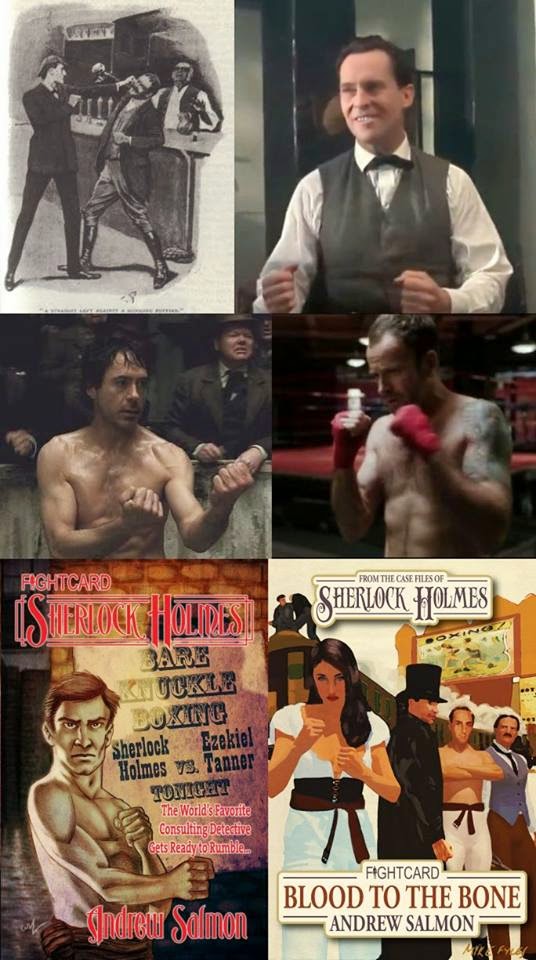
FIGHT CARD SHERLOCK HOLMES: BLOOD TO THE BONE
AUTHOR: ANDREW SALMON
COVER: MIKE FYLES
BOOK DESIGN: DAVID FOSTER
FIGHT CARD SHERLOCK HOLMES: BLOOD TO THE BONE
Deptford, England, 1888 … Richard Stokes – one half of a tag-team carnival boxing duo – has vanished, leaving his loving wife, pugilist Eby Stokes, homeless and penniless with only questions and no answers. A mutual friend asks Holmes to look into the disappearance.
Watson believes the matter to be a common case of abandonment, and Holmes’ interest merely an excuse to try his hand in the boxing booths of a visiting circus. However, when they are almost killed, Holmes and Watson’s only remaining clue to Stokes disappearance harkens back to a boxing club disbanded in shame more than sixty years earlier.
Why did Stokes abandon his wife? What possible significance could the long extinct Pugilistic Club have in the matter? Who is behind the fire that almost took the lives of Holmes and Watson?
Joining forces with Eby Stokes, Holmes and Watson are determined to find the answers. The kaleidoscope lights of the carnival hide many secrets, including a threat to the foundation of the British Empire.
The game's afoot and, this time, it's a matter of life and death in and out of the ring…

Monday, March 2, 2015
BSB REVIEW FIGHT CARD SHERLOCK HOLMES II

THE REVERED BAKER STREET BABES BLOG HAS ALSO GIVEN FIGHT CARD SHERLOCK HOLMES: BLOOD TO THE BONE A RAVE REVIEW ...
While Work Capitol was full of links to the Canon, Blood to the Bone refers more frequently to historical events of the 1880s, ending with a fictionalized explanation for one of the most famous photographs in history (which I will not name, as it would spoil the effect). I enjoyed the historical links and references very much, and loved the solution of the story, which reads almost like an action film – the images conjured up by Salmon’s words are that vivid.
But what sticks most about this story is the lady fighter who is written as a much more complex character than Doyle usually wrote his female characters. She is strong and vulnerable, loving and vengeful, independent and a team player, and she gets an ending very deserving of her character...
FOR THE FULL REVIEW CLICK HERE
Monday, February 23, 2015
BAKER STREET BABES REVIEW FIGHT CARD

THE REVERED BAKER STREET BABES BLOG HAS GIVEN FIGHT CARD SHERLOCK HOLMES: WORK CAPITOL A RAVE REVIEW ...
The case itself is a complex and dangerous one, which sees Holmes and Watson having a close brush with death more than once, and every bit as good as Doyle wrote his cases. I had long wanted to read this story, but was kept from it by work, but now that I sat down again to read it I couldn’t stop and finished it in one go. It’s beautiful prose and while not always sounding true to Doyle, the writing style draws you in and involves you almost physically. Salmon makes you feel the incredible heat of the place when Watson steps inside a crowded bar from the bitter cold. There are many passages in the text where I just stopped to enjoy the words, which is a rare thing in Sherlock Holmes pastiches or any kind of novel these days.
FOR THE FULL REVIEW CLICK HERE
Tuesday, February 10, 2015
BLOOD TO THE BONE REVIEW

YORKTOWN THIS WEEK HAS PUBLISHED AN EXTENSIVE AND LAUDATORY INTERVIEW WITH FIGHT CARD SHERLOCK HOLMES AUTHOR ANDREW SALMON AND A REVIEW OF HIS LATEST TWO-FISTED VICTORIAN OUTING, BLOOD TO THE BONE ...

TO READ THE FULL ARTICLE CLICK HERE
Friday, January 23, 2015
FIGHT CARD UPDATE ~ JANUARY 2015

Our latest Fight Card MMA title, Blood Feud, features Tim Tresslar masquerading as Jack Tunney. Tim has a strong background writing men’s action adventure novels and, in Blood Feud, he gives us a wonderful idea of what a Mack Bolan/ Fight Card mash up might look like.
FIGHT CARD MMA: BLOOD FEUD
Dubai, 2015…David Garrett never could walk away from a fight. Even when a covert mission to nab a terrorist went wrong, leaving fellow CIA agents dead and Garrett holding the bag, he had to be forced to stand down.
Angry and disillusioned, he returned to his native Chicago where he engaged in off-the-books bouts for money, settled scores and made new enemies. Still, the unfinished business eats at him. Then Melissa, his former lover and fellow CIA agent, surfaces. She tells him one of the men responsible for the debacle in Iraq has surfaced. Like Garrett, the man is a fighter and on the card for an exhibition bout in Dubai. Would Garrett come back for one last mission? Garrett never could walk away from a fight. Even one that could kill him…
"This one-two punch from Tim Tresslar has a power not seen since Ali beat Frazier. Blood Feud is a smoking-hot thriller guaranteed to hit so hard you'll see stars the next day still. Go get it – and prepare to stay up all night reading. Yeah, it's that good." Bestselling author Shane Gericke, The Fury
As Fight Card enters 2015 our schedule, due to books on hand, will more than likely be changing to publication every two months. We do have a third Fight Card Sherlock Holmes coming from Andrew Salmon, Job Girl – the sequel to Monster Man – from Jason Chirevas, a yet to be titled outing from Walt Lang, and several other irons heating in the fire.
Thanks to everyone for all you do for Fight Card…
Till next time…Keep punching…
Sunday, January 11, 2015
AVAILABLE NOW ~ FIGHT CARD MMA: BLOOD FEUD
TIM TRESSLAR WRITING AS JACK TUNNEY ...
FIGHT CARD MMA: BLOOD FEUD
Dubai,
2015…David Garrett never could walk away from a fight. Even when a covert
mission to nab a terrorist went wrong, leaving fellow CIA agents dead and
Garrett holding the bag, he had to be forced to stand down.
Angry
and disillusioned, he returned to his native Chicago where he engaged in
off-the-books bouts for money, settled scores and made new enemies. Still, the
unfinished business eats at him. Then Melissa, his former lover and fellow CIA
agent, surfaces. She tells him one of the men responsible for the debacle in
Iraq has surfaced. Like Garrett, the man is a fighter and on the card for an
exhibition bout in Dubai. Would Garrett come back for one last mission? Garrett
never could walk away from a fight. Even one that could kill him…
Saturday, December 13, 2014
FIGHT CARD ROMANCE: LADIES NIGHT CHRISTMAS

A FIGHT CARD SHORT STORY WITH A TOUCH OF ROMANCE ... ONLY 99¢ ...
FIGHT CARD ROMANCE: LADIES NIGHT CHRISTMAS
Christmas, 1955 … Hollywood Legion Stadium …
Light heavy-weight champ, Jimmy Doherty is boxing Carlo ‘Toro’ Bassani for the Christmas benefit, even though Jimmy is sure Toro is under the thumb of gangster, Mickey Cohen. He doesn't know if Toro will deck him with a ‘Sunday punch’ in the first round or flop in the third. Even though Jimmy feels sorry for the pug who has cast his lot with the devil, he isn’t sure if he should give this boxer an early Christmas gift of his self-respect, by forcing him to fight like a man, or let Toro kiss the canvas.
Jimmy's bride, Lindy Doherty, is front row center where she always is when he fights. Not many dames would stay in their man's corner consistently cheering him on. She's taking in the action and praying her husband won't get his head handed to him on a Christmas platter. While waiting to watch Jimmy duke it out in the center ring, she and her six month old son, Patrick, along with her two Precious Roses, meet the brightest star in the Hollywood Christmas sky.
Can Jimmy retain his light heavy-weight title and keep a fellow boxer from accidently ‘falling’ off the San Pedro Pier? And what is Lindy’s special Christmas gift for Jimmy?
Tuesday, December 2, 2014
UP TO SCRATCH

UP TO
SCRATCH
ON WRITING
FIGHT CARD
SHERLOCK HOLMES BLOOD TO THE BONE
ANDREW
SALMON
Blood to the Bone is the second Fight Card Sherlock Holmes tale to be penned by award winning Sherlockian author Andrew Salmon. His first Fight Card Sherlock Holmes novel, Work Capitol, is also available on as a Kindle e-book and in paperback…
The first novel in the Fight Card Sherlock Holmes series, Work Capitol, presented a number of daunting challenges. Not only did I have to learn how Victorian fighters plied their trade, but also how Sherlock Holmes would put his inimitable spin on the science of pugilism. Added to that was the responsibility of discerning how Watson would describe a fight in the language of the time.
Research and a lot of pondering led me to the solutions. Hearing from readers since the book's release, I was pleased to see these solutions were met with positive reactions. The book even snagged an award nomination along the way. Holmes fans enjoyed the book, which was a tremendous relief to me and the Fight Card team.
Now, all I had to do was pull it off again! More than that, actually, as the second book could not and should not be just more of the same. No matter how much readers liked Work Capitol, the new one had to be different. We writers don't like to repeat ourselves.
Well, with the fight stuff all worked out and a first attempt at determining how Watson would narrate a boxing match successfully under my belt, I felt I was slightly ahead of the game. Also, in my research for the first book, I had collected a vast treasure trove of information, trivia, dates, events, names, places, etc.
One of those pieces was supposed to be an important clue for Holmes to discover in Work Capitol – except, when all was said and done, I'd forgotten to use it! So, I had that in my back pocket for the second book as well. Hey, it was a good clue – far too important to throw away.
Next came a read through of Sir Arthur Conan Doyle's bare knuckle boxing novel, Rodney Stone, to set the tone. The novel provided me with an opportunity to pay homage to Doyle – we must never forget, it is his sandbox modern day Holmes scribblers play in after all.
My tip of the deerstalker takes the form of the pub Holmes, Watson, and my female fighter visit as the Waggon and Horses is visited by Doyle's characters in his book. What's funny, when you think about it, is that, really, two sets of his characters visit the pub a century apart in real time. Rodney Stone also gave me the title for my book, Blood to the Bone, from a phrase used to describe a true blue fighter common at the time.
With all of the above in my corner, I felt pretty good about the next book. And the research sealed the deal. We historical fiction writers are like fishermen. We cast our nets upon history in the hope of finding something interesting, something different, unsung, something today's readers may or may not know about, but we think they'd get a kick out of reading about.
My nets landed smack dab in the middle of the forgotten Victorian female pugilists of the 1800s. As the first book had not featured a female lead, this find immediately struck me as something different yet still staying well within the world of bare knuckle boxing. Endless research showed me the female fight game was a great element, which simply couldn't be ignored.
But how the heck was Holmes going to fight in the women's ring? Stumbling upon the tag-team aspect of women's boxing saved the day. Discovering that couples used to face off against other couples with the ability to tag up like wrestlers and switch partners saved my bacon. Holmes and my female lead could now step up to the scratch line together. Phew!
But what brought them together? Wait a minute! Tag-team couples! What if a husband in one of these tag-teams suddenly disappeared and Holmes and Watson were asked to investigate? Yeah, that would work. Okay, I had Victorian circuses, the forgotten boxing booths of the time, the somewhat obscure history of female bare knuckle boxing, a couple of other little known chapters of history (too spoilerish to talk about here) and a lunar eclipse thrown in for good measure. We were off to the races.
Then tragedy struck.
I had my ducks in a row, the opening scenes playing out in my mind and on my computer screen as I typed away, when my wife's best friend, Linda Gavin, passed away suddenly in July. Best friend? They had been as close as sisters these last 18 years. My wife's grief took precedence and the tale was set aside as we struggled through the shock of it. There was the celebration of life memorial to attend as well and this was a moving, unforgettable event – one we should all hope for when our time comes.
It was during this sad time I got the idea to model the female fighter in my Holmes tale after Linda. No small tribute, as Linda was a strong believer in gender equality and would have adored the character of Eby Stokes but, also, her husband, Doug, was a life-long Sherlock Holmes fan.
I had named a character after Doug in two previous Holmes tales a different publisher had brought out in recent years much to Doug's delight. As one always feel helpless when tragedy strikes another, here was something I could do for Doug, and he was moved when I told him of my plans at the memorial. I told him I would be dedicating the book to Linda as well as changing the name of my female fighter to Eby Stokes – Eby being Linda's maiden name.
I took things a step further by asking cover artist Mike Fyles if he would be willing to use Linda's likeness for his depiction of Eby Stokes. Mike's a great guy and readily agreed. I sent him off a pair of shots of Linda in her youth (boxing is a young man's and young woman's game) and he came back with the incredible cover you see on the book.
Things got a little spooky with the cover.
Take a look at his rendition of Eby Stokes. She does indeed resemble Linda, but what he did not know was that she always posed for photos with her hair down in front of her left shoulder. Always – except in the shots I sent Mike, as these had been shots of her in her youth.
I had made no mention of it to Mike, wanting him to be free to go where his considerable talent took him. Yet there is Eby Stokes with her hair hanging down in front of her left shoulder! Coincidence? Something more? We can each come up with our own answers. It sent chills down my spine, that's all I have to say about it.
As I gradually got back to writing the tale, the book took on more personal importance to me. Holmes tales deal with logic, deduction and adventure, not overburdened by emotion. This being my eighth Holmes tale, I was well versed in this. But now the book was to be my tribute to our departed friend. I had to make it a fitting tribute and I had to create an Eby Stokes to make Linda proud.
Have I succeeded? That's up to you, dear readers. I gave it everything I had, but the proof is in the reading, and I hope the story entertains and keeps you guessing.
It was a bitter-sweet experience writing Blood to the Bone. Thanks for getting this far with me and I hope you enjoy the book.
WOMEN PUGILISTS GET THEIR DUE

WOMEN
PUGILISTS GET THEIR DUE
VICTORIAN
FEMALE BOXERS
ENTER HALL OF FAME
ENTER HALL OF FAME
ANDREW
SALMON
Blood to the Bone is
the second Fight Card Sherlock Holmes tale to be penned by award winning
Sherlockian author Andrew Salmon. His first Fight Card Sherlock Holmes novel,
Work Capitol, is also available on as a Kindle e-book and in paperback…

The Bare Knuckle
Boxing Hall of Fame in Belfast, New York held an
induction ceremony on July 12th, 2014, where the great, unsung female boxing
greats of the Victorian age took their place amongst the legendary male
fighters of yesteryear as part of the rich history of the sport.

Elizabeth Wilkinson
(Stokes): Winner
of first ever recorded female bare knuckle fight in 1722.
Anna Lewis: Staged first Women's Championships, brought
publicity to the sport in the 1880s.
Hattie Stewart: First Female Bare Knuckle World Champion,
1884.

Hattie Leslie: First American Championess, 1888.
Alice Leary: A six-foot slugger, athlete, was 52-0 w/24
knockouts before losing to Hattie Leslie.
Hessie Donahue: Knocked out John L. Sullivan in 1892.

These great fighters, along with a selection
of modern day women pugilists, join the ranks of past inductees, including John
L. Sullivan, Jem Mace, James Figg, Jack Dempsey and dozens of others.
Subscribe to:
Posts (Atom)